
The Impossible Game - Mastering The Impossible Game's Ultimate Challenge
Master The Impossible Game's brutal one-button platformer where your orange cube faces instant-death obstacles synced to pulsing beats—7 million players have proven this impossible challenge can be conquered through pure skill, muscle memory, and relentless determination across pixel-perfect jumps.
Please wait a moment for the The Impossible Game game to load after clicking "Play Now" button.
Play The Impossible Game in Browser Online
Recommended Games
View all
The Impossible Game can be beaten—but only if you’re willing to fail hundreds of times first. This brutally honest rhythm-platformer has frustrated and fascinated millions of players since its release, turning a simple orange cube into one of gaming’s most notorious challenges. What appears as a straightforward obstacle course quickly transforms into a test of nerves, muscle memory, and sheer determination.
With over 7 million downloads across platforms and spawning countless imitators, The Impossible Game earned its reputation by doing what few titles dare: refusing to hold your hand. One button controls everything. One mistake restarts everything. One level can take hours—or days—to conquer.
Key Takeaways:
- Single-button gameplay strips away complexity to expose raw skill
- Zero forgiveness policy means every jump must be pixel-perfect
- Rhythm-based obstacles sync with pulse-pounding soundtracks
- Practice Mode exists but victory only counts in full runs
- Global leaderboards prove completion is possible, just improbable
What makes this orange cube so addictive? Why do players return after their 500th death? The answer lies in how brilliantly the game balances impossibility with achievability—always keeping success just one perfect run away.
How To Play The Impossible Game
The Impossible Game throws you into a world where one button controls your fate. Your cube races forward without pause, and you tap to jump—that’s it. Sounds easy, right? Wrong. Every spike, every gap, every raised block waits to end your run instantly. One touch means total failure, forcing you back to square one. This brutal loop tests your nerves harder than most games dare.
Timing becomes everything when the ground beneath you turns deadly. You can’t slow down or take breaks—the cube pushes ahead relentlessly. Each obstacle demands split-second decisions that separate success from disaster. Miss by even a fraction, and you’re done. The game strips away second chances, leaving only pure skill between you and victory. Your fingers must react before your brain fully processes what’s coming.
Learning through pain defines the core experience here. Early attempts feel chaotic and random, but patterns emerge after dozens of failures. You’ll notice spike clusters repeat in specific rhythms. Platforms appear at predictable intervals once you’ve died enough times. This isn’t about luck—it’s about burning obstacle layouts into muscle memory. Practice Mode lets you drop checkpoints anywhere, turning impossible sections into manageable chunks. Study one deadly segment until you nail it, then move forward.
However, true completion requires perfection from start to finish. Practice helps you survive, but the real challenge demands flawless execution across entire levels. No checkpoints. No safety nets. Just you, the cube, and hundreds of ways to fail. Each clean run feels earned because you’ve conquered every inch through discipline and focus. The game respects your time by making victory meaningful, not easy.
Concentration breaks down faster than you expect under constant pressure. Your eyes track obstacles while your finger hovers over the jump button. Hesitate for one moment, and you crash. Panic during a tricky sequence, and you’re toast. The mental stamina needed here rivals physical games—staying calm through repeated failures separates casual players from masters. You’ll learn to reset your mindset after each death, approaching the next attempt with fresh focus instead of mounting frustration.
Features Of The Impossible Game
One-button control strips this platformer down to its essence. You won’t find complex combos or weapon systems here. Jump or don’t jump—that’s your entire toolkit. This simplicity makes The Impossible Game brutally honest about skill. You can’t blame bad controls or confusing mechanics when you fail. Every mistake traces directly back to your timing, your focus, your execution. The design forces you to confront your limits without excuses.
Instant death mechanics create a unique addiction loop that hooks players hard. Most games cushion failure with health bars or continue systems. Not here. Touch anything dangerous, and you restart immediately. This unforgiving approach sounds frustrating, yet it builds incredible motivation. Each attempt feels fresh because you’re always one perfect run away from victory. The gap between failure and success stays razor-thin, keeping hope alive even after hundreds of deaths.
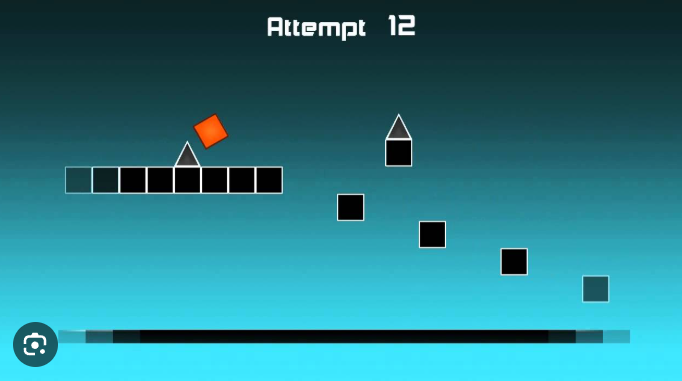
Visual minimalism removes every possible distraction from the screen. Clean geometric shapes replace detailed graphics. Solid colors mark safe zones and deadly traps without ambiguity. Your cube stands out clearly against stark backgrounds, making spatial awareness easier despite the speed. This stripped-down aesthetic serves gameplay first—you’ll never die because you couldn’t see an obstacle. Everything visible matters, and everything that matters stays visible.
| Feature | Purpose | Player Benefit |
|---|---|---|
| Auto-scroll | Constant forward motion | Builds pressure and urgency |
| Practice Mode | Checkpoint placement | Analyze tough segments safely |
| Single button | Jump-only control | Pure skill expression |
| Minimal design | Remove visual clutter | Total focus on obstacles |
Progressive difficulty escalates in ways that feel fair yet crushing. Early sections teach basic timing through simple jumps. Then the game layers in tighter gaps, faster sequences, and deceptive rhythms. Each new challenge builds on skills you’ve already developed, creating a learning curve that’s steep but climbable. You’re never thrown into chaos without preparation—just pushed slightly beyond your current comfort zone with each attempt.
Reputation within gaming culture grew from this game’s influence on modern platformers. Platform games shifted toward precision-focused design partly because The Impossible Game proved players crave genuine challenge. The cube aesthetic, rhythm-based obstacles, and one-hit-death formula spawned countless imitators. Yet the original maintains its edge through tight design that respects player intelligence while testing their limits relentlessly.
Similar Games
Final Words
The Impossible Game stands as gaming’s perfect storm of simplicity and suffering—a single orange cube that has humbled millions. This rhythm-platformer doesn’t ask much: press one button, avoid obstacles, reach the end. Yet between those three steps lies a gauntlet that transforms casual players into obsessed perfectionists. Every spike cluster becomes a personal nemesis. Every failed attempt fuels another try. The game’s genius lies in making “impossible” feel conquerable through pure persistence and pattern recognition.
What separates this from typical rage-quit fodder? The design respects your intelligence while punishing your mistakes. Practice Mode teaches without coddling. Minimal visuals eliminate excuses. The soundtrack pulses in sync with deadly obstacles, turning spatial awareness into rhythmic intuition.
Seven million downloads prove that players crave authentic challenge when it’s delivered fairly. Your cube won’t gain new abilities or power-ups—victory demands you level up instead.
New Games
View all




Previous
Mr Meat House Of Flesh
Next
Granny 4
Discuss The Impossible Game